
🏛️ How AI Will Implode the Enterprise — And Why JPMorgan Just Sounded the Alarm ⏰
JPMorgan’s CISO Open Letter Isn’t Just About AI — It’s About the Fragile Foundations We Forgot to Secure

In 1996, cyberspace declared independence at the World Economic Forum.
In 2025, Wall Street declared, “We may have lost control.”
JPMorgan’s CISO, Patrick Opet, released a rare and urgent Open Letter to their suppliers. It wasn’t just a compliance note, but a full-throated call for sanity in an AI-fueled, API entangled digital economy circus. 🎪
It basically says;
🚨“The security controls in our SaaS and AI supply chain are no longer fit for purpose.”
JPMorgan— Open Letter to Our Suppliers
I know exactly what he means, as I’ve historically designed access and security controls in SaaS solutions. 👀
Translation?
We’ve built AI skyscrapers on SaaS sand. And now the cracks are visible from orbit. 🛰️
This wasn’t just a memo. It was a moment.
A signal flare for the entire enterprise ecosystem.
And yes, I laughed — darkly.
Because this feels like a Declaration of Cyber-Dependence — the tragic sequel to John Perry Barlow’s 1996 Declaration of the Independence of Cyberspace.
🎤 It landed like a mic drop across CISO circles — articulating what security teams have been warning about for years. (I can hear security folk secretly chuckle too with “told you so” :P)
And when the largest bank in the U.S. publicly admits their digital supply chain is structurally insecure?
You hope the smart money pays attention. 👀
Welcome to the start of the AI apocalypse.
🔁 1996 vs. 2025: Two Declarations, 30 Years Apart
In 1996, Barlow declared independence.
“I declare the global social space we are building to be naturally independent of the tyrannies you seek to impose on us.”
In 2025, Opet declares we’ve lost it.
“I declare the vendor ecosystem we built is accidentally dependent on security models we never verified, and integrations no one understands.”
Today, an over caffeinated CISO, 200 vendors deep into third-party risk reviews, is wondering how many AI agents have admin access to production.
While Barlow wanted to keep the internet free, Opet just wants to make sure it doesn’t implode during earnings week.
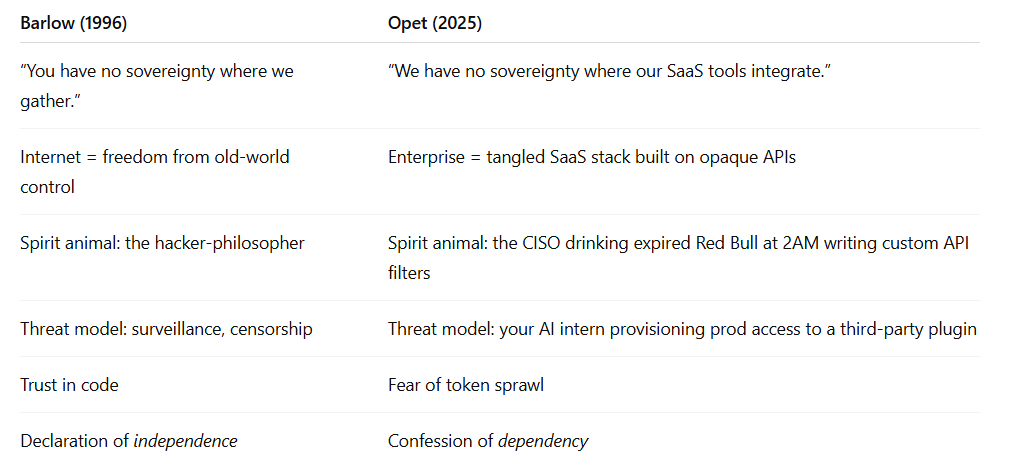
Barlow’s cyberspace was rebellious. Romantic. Borderless. He fought for independence from control.
Opet’s SaaS-space is interconnected, invisible, and deeply insecure. He is fighting for control over our dependence.
One wrote poetry.
The other filed an incident report and a vendor SLA escalation in the same afternoon.
And yet... they’re both right.
Barlow warned us not to replicate the sins of the physical world online.
Opet is warning us that we already did — just with more dashboards, fewer guardrails, and AI agents doing “low-risk automation tasks” like editing HR policy and provisioning cloud access.
🧠 Psychology Meets Security: The Illusion of Control
Barlow feared that governments would impose control over digital citizens.
Opet fears that no one is in control — not even the vendor whose AI assistant now has write access to your CRM.
Today, we trust dashboards, certifications, and annual audits - not because they protect us, but because they feel reassuring.
But most of our trust is outsourced.
We feel safe because a vendor is “ISO-certified.”
We feel in control because we filled out a risk assessment.
But as any social psychologist will tell you:
Humans are wired to confuse visibility with safety.
That’s how we end up with 300 SaaS integrations, 2 AI copilots, and nobody noticing until the quarterly earnings call slides get pushed to a public Notion board.
We didn’t replace governance.
We buried it under invisible APIs, autonomous agents, and the illusion of security — wrapped in a PDF and stamped “Compliant.”
We weren’t breached.
We granted access. At scale.
We auto-integrated ourselves into entropy.
🧨 Fortresses Turned Freeways
A few painful truths from JPM’s CISO Open Letter:
Zero Trust has become Zero Context. We’ve replaced segmentation with “magic portals”. Now it's tokens and APIs flowing unchecked.
Innovation > Hygiene. “Ship fast and patch later” doesn't scale when your AI agent/copilot has root access.
AI is the Great Risk Multiplier. One SaaS tool with elevated permissions becomes an AI agent with cognitive autonomy and unmonitored access.
Trust Without Verification. A psychological trap. Dashboards and vendor logos aren’t control mechanisms.
🧱 Fragile Foundations, Fancy Features
We’ve built modern enterprises like this:
🔨 Infrastructure: Outsourced
🔌 Integrations: Invisible
🤖 Intelligence: Autonomous
🔐 Security: Optional toggle (disabled by default)
That’s why JPMorgan’s CISO message should be your board’s new north star:
📜 JPM’s CISO Call to Arms:
Security must be built-in — not bolted on
Vendors must prove their controls work — continuously, not annually
Integrations must be governed — before AI agents are unleashed
Security must be treated like engineering — not insurance or optics
🏛️ For Boards: This Is Your Sarbanes-Oxley Moment
This is no longer a “CISO issue.”
It’s a governance crisis masquerading as a tooling problem. It’s a systemic governance failure.
Ask yourself:
How many SaaS tools does your company use?
How many have API access to critical systems?
How many AI agents have been granted access via those APIs?
Who is tracking that? Validating it? Containing it?
If you don’t know — you’re not alone.
But in 2025, ignorance is no longer plausible deniability. It’s negligence.
🛑 TL;DR:
We declared independence in 1996.
We built complexity in 2020.
And now, we’re declaring we need help.
JPMorgan’s CISO Open Letter is the wake-up call.
And the “SaaS is fine” crowd? Suspiciously quiet.
Final Thought:
We didn’t lose control overnight.
We gave it away — one Slack app, one AI plugin, one unchecked integration at a time.
We trusted by default.
We assumed visibility we never had.
We believed “secure by design” meant “secure in reality.”
AI didn’t break the enterprise.
It just showed us how fragile it already was.
So what now?
We rebuild.
With architecture, not assumptions.
With continuous validation, not PDFs.
With real board oversight, not compliance theatre.
Because a problem shared is a problem halved.
And this one touches every vendor, every system, every decision.
It’s time to take back control — before the next AI-powered assistant emails your roadmap to:
CollabAI_SuperSync_v3 🙀
CISOs, you’ve got air cover.
The biggest bank on Wall Street just said the quiet part out loud.
⏰ Time to fix the foundation — before the next shiny integration becomes your blast radius. 💥
#DigitalTrust #AIsecurity #CyberResilience #BoardGovernance #CISO #JustAskPenny #AI #Cybersecurity #TechDiplomat
Like your cybersecurity with a shot of strategic insight and a twist of dry humour?
Subscribe to TechDiplomat — where we brief boards, challenge defaults, and translate tech chaos into governance clarity. 📗 justaskpenny.substack.com
Also read … https://justaskpenny.medium.com/how-to-torture-your-suppliers-with-privacy-and-security-questionnaires-2c77d00539a6